ScienceTechniqueGluten
Autolysis vs. Fermentolysis: The Science of Better Bread
8 min read
Intermediate
Master the art of gluten development. Learn when to use autolysis vs. fermentolysis to boost enzymatic activity, structure, and flavor in your sourdough.
 ArtisanCrust
Stiff dough? Tearing when you try to stretch it? Many home bakers struggle with rubbery dough that fights every fold. The secret isn't more kneading — it's passive work.
A 90-minute rest with just flour and water can replace 10 minutes of intensive mixing. Introduced by Raymond Calvel in 1974, autolysis transforms a rough, shaggy mass into a fine, extensible dough — without you lifting a finger.
Just flour and water. Passive gluten development and enzyme activation before the starter is added.
Flour, water, and starter. Active fermentation begins immediately alongside gluten development.
Autolysis (from the Greek auto meaning "self" and lysis meaning "splitting") is a technique introduced by French baking professor Raymond Calvel in 1974. In its purest form, it is the process of mixing only flour and water and letting them rest before adding salt, yeast, or starter.
During this passive rest period, two critical things happen:
For the home baker, this means less kneading time and a dough that is much easier to handle.
While hydration is visible to the naked eye, the real magic happens on a microscopic level. Two primary enzymes kick into gear once water meets flour: Protease and Amylase.
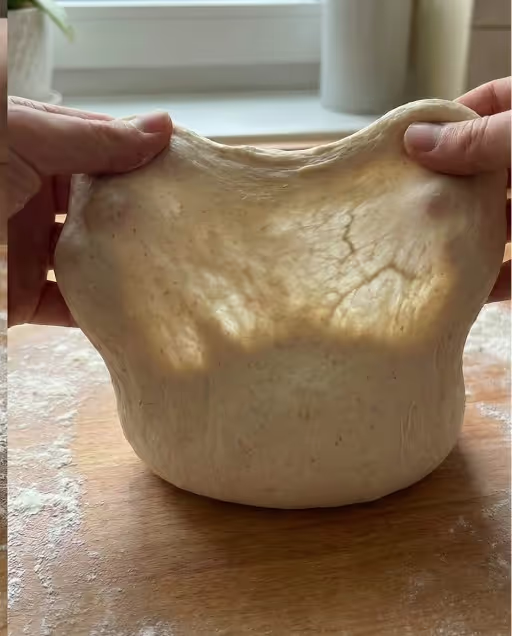
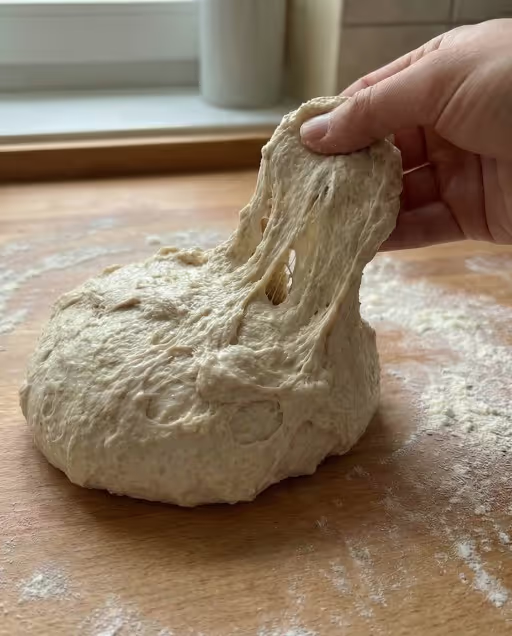 Before
Salt is hygroscopic (it attracts water) and creates osmotic pressure. If added too early, it competes with the flour for water and can tighten the gluten network prematurely, inhibiting the enzymes from doing their best work.
For sourdough bakers, pure autolysis runs into a logistical wall. Folding a stiff, active starter into a dough that already has a gluten network is hard work, and usually demands more mixing than the autolysis was meant to save. (All of this assumes you have a lively starter on hand; if you don't yet, here's how to make a sourdough starter from scratch.)
Enter Fermentolysis.
Fermentolysis involves mixing flour, water, AND the sourdough starter right at the beginning. Salt is still withheld.
| Feature | Autolysis (Classic) | Fermentolysis (Hybrid) |
|---|---|---|
| Ingredients | Flour + Water | Flour + Water + Starter |
| Best For | Commercial Yeast / Liquid Doughs | Sourdough / Stiff Starters |
| Typical Duration | 20 mins - 2 hours | 30 mins - 1 hour |
| Acid Load | Neutral (pH ~6.0) | Acidic (pH drops quickly) |
Whether you choose autolysis or fermentolysis, the goal is to optimize your dough before the heavy lifting of bulk fermentation begins.
Temperature Warning: If your kitchen is very warm (>28°C / 82°F) and you are using fermentolysis, do not let the dough sit for more than 45 minutes. The starter is active! The enzymes might over-degrade the gluten, leading to a sticky, soupy mess.
Salt acts as the "brakes" for enzyme activity. By delaying it, we essentially take the foot off the brake pedal, allowing the enzymes to speed up gluten development and sugar production. Just remember to add it eventually, or your bread will taste bland and have a pale crust.
After a few hundred bakes, I've learned that 45 minutes at 24 °C is the sweet spot for ordinary bread flour. Push past 90 and the dough starts to feel like it's giving up: slack, sticky, no spring left in it.
Use science in your kitchen! Calculate the exact proportions for your test dough in the Lab.
Autolysis is more than a technique — it's a philosophy of letting time do the work. Once you build it into your rhythm, you'll never again knead a dough that fights you back.
Look for visual cues: the dough has increased by about 30-50% in volume, the edges are domed against the bowl, and it "jiggles" elastically when shaken. Tiny air bubbles should be visible just under the surface.
Bacteria produce too much acid, which begins to break down the gluten network. The dough loses its structural integrity, becomes sticky, and will "pancake" in the oven instead of showing a strong oven spring.
Higher temperatures favor lactic acid bacteria but also accelerate acetic acid production if the starter over-matures. In the heat, the fermentation "gas pedal" is floored, making it easier to overshoot the optimal flavor profile.