TechniqueBakingCrust
Scoring and Baking: How a Knife and Steam Build the Ear
9 min read
Intermediate
Why the slash, the steam, and the oven spring are one event — and the eight-step bake that turns a flat loaf into one with a real ear.
 ArtisanCrust
Seven o'clock in the morning. Coffee, oven preheated to 250°C, dough fresh from the fridge. You score a confident curve down the middle and slide it in. Twenty minutes later you peek, expecting drama, and instead see a flat loaf with a sad ridge where the cut sealed itself shut.
That's not a knife problem. That's not even a fermentation problem. That's the moment the whole choreography came apart, and to fix it you have to stop thinking of scoring and baking as two separate things.
A loaf going into a hot oven is a pressurised vessel. Inside that taut skin you built during shaping, the alcohol your wild yeast left behind starts to vaporise around 78°C, water flashes to steam above 100°C, and the gas trapped in every bubble expands by roughly a third before the yeast finally die at 60°C internal. All of that pressure has to go somewhere. The skin you spent so long tightening is also a wall; without a planned exit, the gas finds its own door, usually along the seam at the bottom or wherever the skin is thinnest.
Score the loaf and you give that pressure a contract. The cut is the planned weak point. Everything else can hold while the dough swells outward through the slash.
That's why a score isn't decoration. It's pressure management.
Here's the part that surprised me the first time I measured it. The reason professional bakeries inject steam for the first ten minutes isn't to make the crust shiny. It's to keep the crust pliable long enough for the loaf to finish rising.
A dry crust starts to set within three or four minutes in a hot oven. Once that surface goes from soft to leathery, oven spring is over, even if the inside still has gas to give. Add steam, and the surface stays elastic for ten to twelve minutes instead of three. That's the entire window your loaf has to grow into the shape you scored for.
There's a second reason, and it's the one that actually does the visual work. Water vapour transfers heat to a cold surface roughly 5–10 times faster than dry air, because every droplet that condenses on the dough dumps its latent heat into the skin. Your loaf starts cooking from the outside almost instantly. The surface starches gelatinise into a glossy set, sugars rise to the top, and when you vent the oven at minute 20, Maillard kicks in on a surface that's already primed.
That's where the deep amber and the crackle come from. Not from the heat. From the timing.
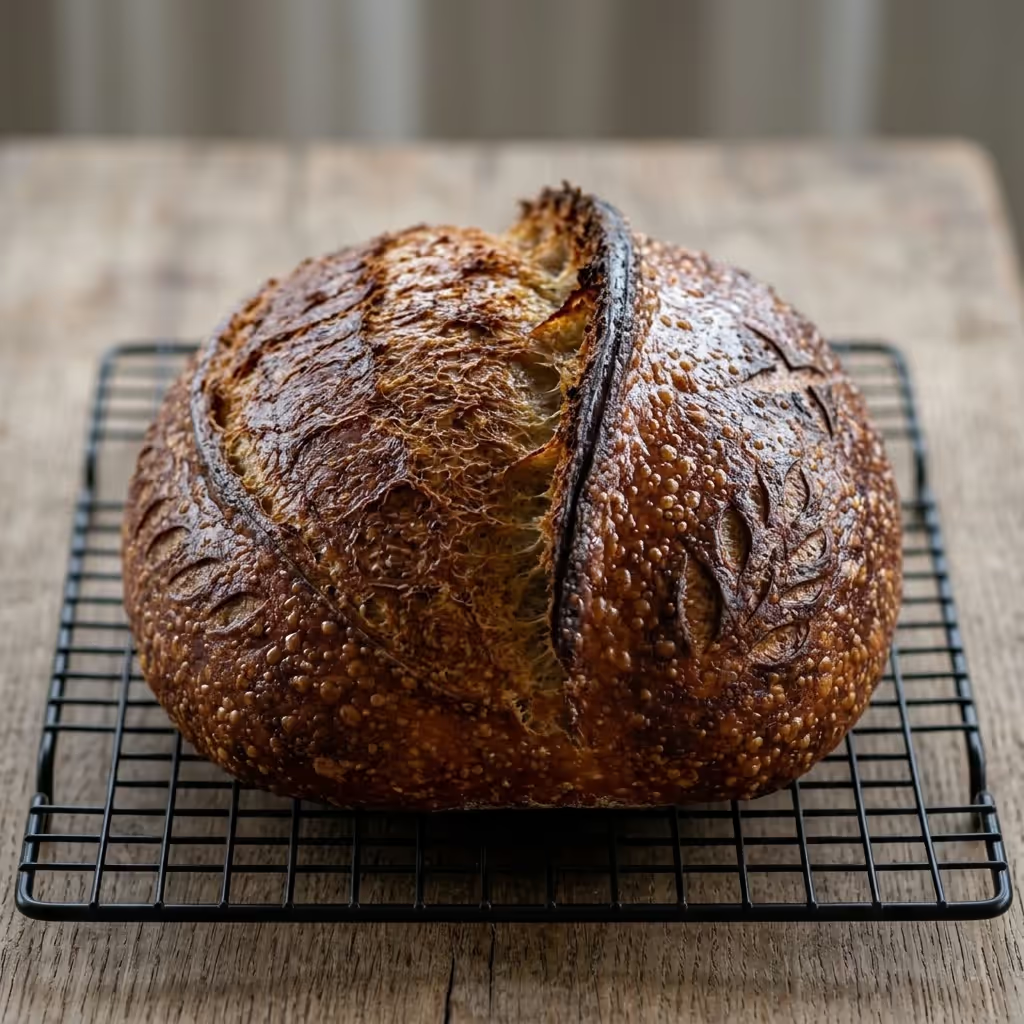
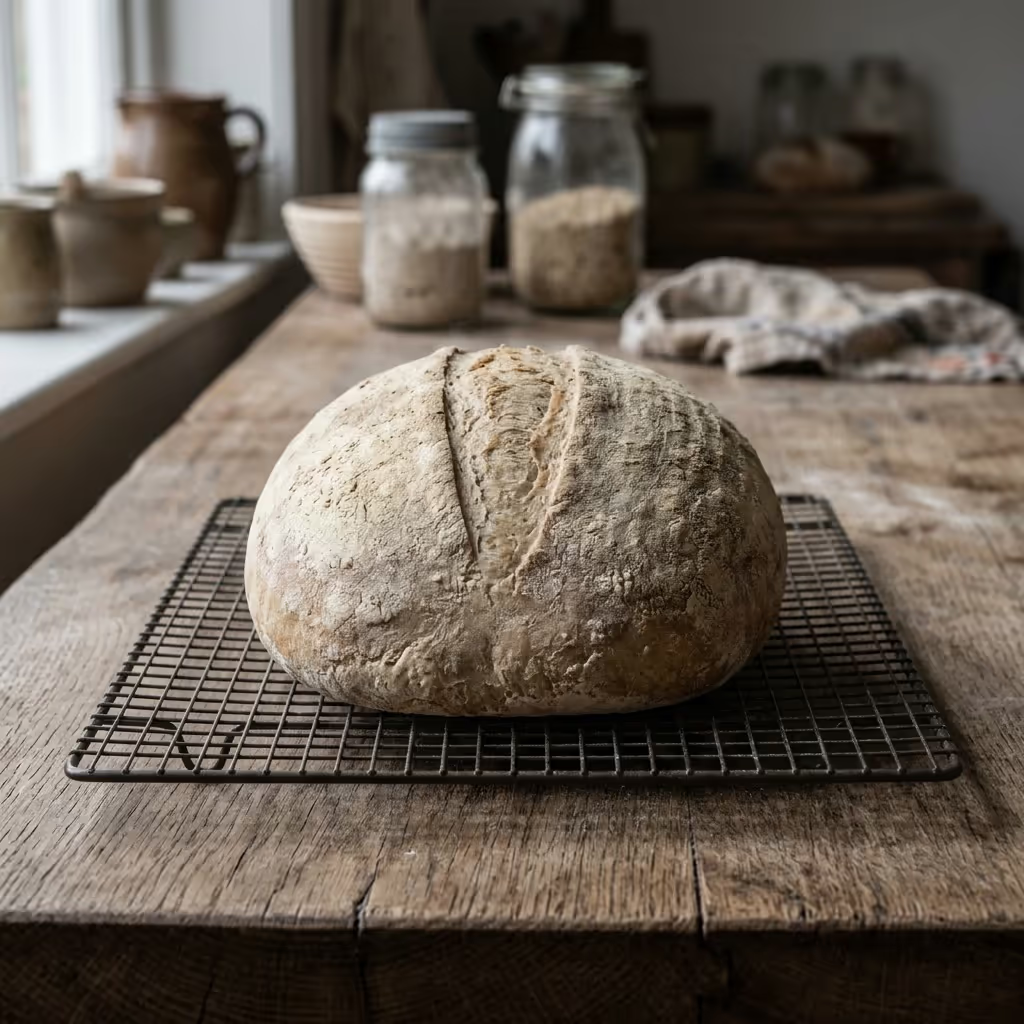 No steam
People use the words like they're interchangeable. They aren't. Both make brown things, but they're two different reactions, and a sourdough crust is mostly one of them.
Maillard kicks in around 140°C on the dough surface. It's the reaction between an amino acid and a reducing sugar, both of which your dough has plenty of after a good cold retard. The output is a chain of complex molecules that smell like roasted nuts, fresh bread, malt, and a hundred other things you can't name but recognise instantly. This is the dominant flavour and colour reaction in the crust.
Caramelization is sugar alone, breaking down under heat, starting around 160°C. It contributes the buttery sweetness in the very darkest spots of the crust and the slightly bitter edge of an over-baked ear. There's much less of it than Maillard, but you taste it.
If your crust is pale, you don't have a colour problem. You have a temperature-and-timing problem. Either the surface didn't reach 140°C in the first ten minutes (oven not preheated long enough, or steam never turned off), or there weren't enough free sugars on the surface to react (rushed cold retard, weak amylase activity, dough mixed too short). The crust is the report card on everything that came before.
You can bake a great loaf in any of them. They just play to different strengths.
Dutch oven (cast iron with lid): The forgiving choice. The lid traps the dough's own moisture, which is more than enough steam for the first 20 minutes. No boiling water, no kettles, no scalded forearms. Thermal mass is high, so the bottom of the loaf gets a strong burst of conductive heat. The downside: you're committed to one loaf at a time, and the ceiling above the dough is closer than ideal, so very tall boules can hit the lid mid-spring.
Baking stone (ceramic or cordierite): Lighter, cheaper, and you can bake two loaves at once. Heat transfer is slower, so the bottom crust is gentler, which is better for high-hydration doughs that would otherwise burn underneath. You have to inject steam yourself: a tray of boiling water on the rack below, or a few ice cubes onto a hot pan at the moment of loading.
Baking steel: The hardcore option. Steel conducts heat about 18 times faster than ceramic, so the bottom of the loaf gets a brutal initial burst — perfect for pizza, slightly aggressive for bread. If you use one for sourdough, drop the preheat to 230°C instead of 250°C, or you'll burn the bottom before the top has a chance to colour.
A small thing nobody mentions about Dutch ovens: they need the full 45-minute preheat with the lid on, not just the empty time the oven took to hit temperature. Cast iron's whole advantage is its thermal saturation. An under-preheated Dutch oven gives you a worse bake than a well-preheated stone.
Here's the workflow I'd run with a loaf that's been in the fridge overnight:
After about 500 bakes I stopped trusting my eyes for doneness and started trusting the probe. A crust can look perfect at 92°C and still cut into a damp, gummy middle. The thermometer is a $15 honesty check on five hours of work.
Try baking the Classic Country Loaf to see these principles in action.
Use the Lab to dial in hydration, salt and timing — so by the time the oven hits 250°C, the dough is the easy part.
The cut isn't a wound. It's a door you build for the loaf to walk through. Steam holds the door open long enough for the spring to finish, Maillard paints the frame, and the rest is just heat doing what heat does. Once you see scoring and baking as one event with two hands, the loaves stop being lucky. They start being yours.
Look for visual cues: the dough has increased by about 30-50% in volume, the edges are domed against the bowl, and it "jiggles" elastically when shaken. Tiny air bubbles should be visible just under the surface.
Bacteria produce too much acid, which begins to break down the gluten network. The dough loses its structural integrity, becomes sticky, and will "pancake" in the oven instead of showing a strong oven spring.
Higher temperatures favor lactic acid bacteria but also accelerate acetic acid production if the starter over-matures. In the heat, the fermentation "gas pedal" is floored, making it easier to overshoot the optimal flavor profile.