
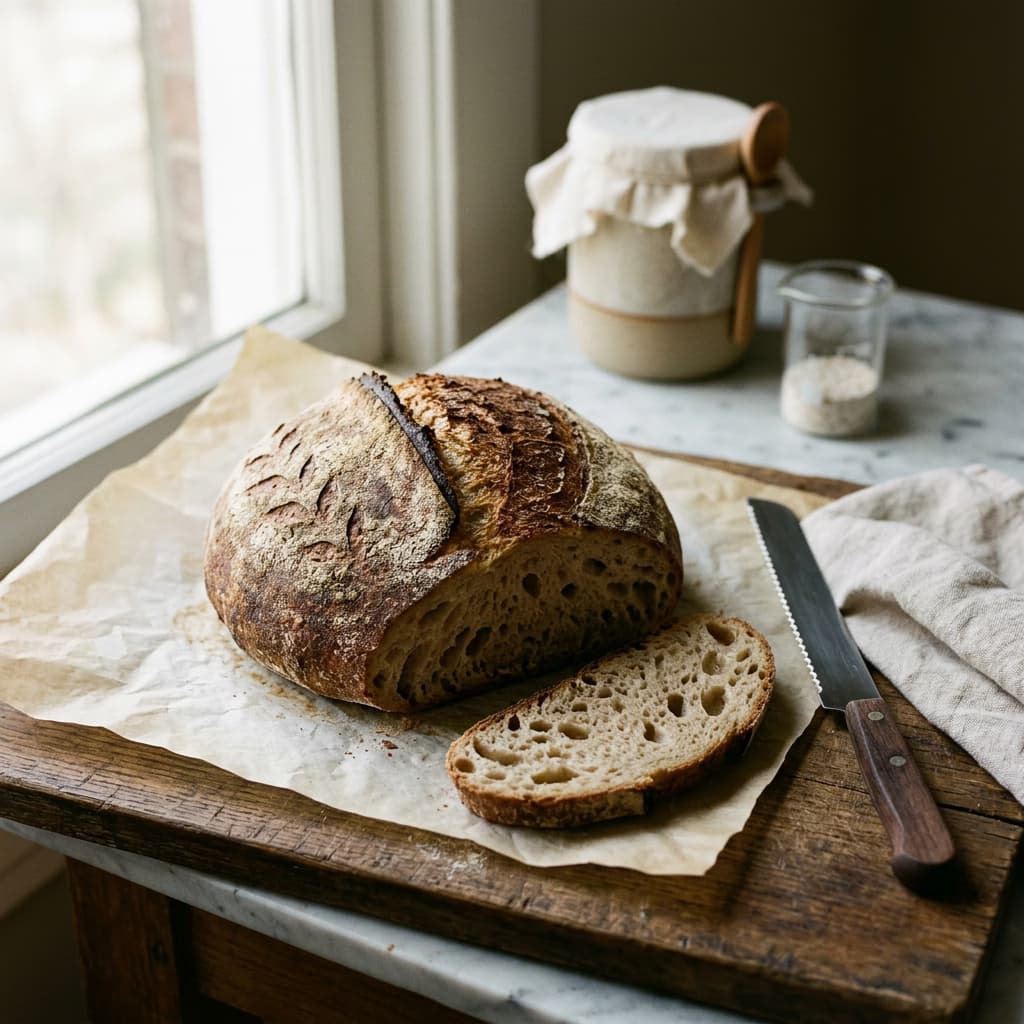
Easy Sourdough Bread for Beginners
The most forgiving sourdough loaf you can make: just one flour, minimal shaping, a long ambient bulk fermentation, and an overnight cold proof. Genuine sourdough flavor with none of the stress.
Sourdough Math
Adjust the starter amount to scale the recipe.
Ingredients
Required Tools
Autolyse
Refined flours absorb water quickly but need time for gluten to align without acid interference.
Learn More →Steps
Mix the active starter and water in a large bowl until the starter is fully dissolved. Add the bread flour and stir until no dry flour remains. The dough will look rough — that is normal. Cover and rest for 45 minutes.
Sprinkle the salt over the dough, then use wet hands to squeeze and fold it in until fully incorporated. Cover and let the dough undergo Bulk Fermentation at room temperature for 6–8 hours. The dough should increase by 50–75% and show bubbles on the surface and sides.
Optional but helpful: during the first 2 hours, perform 3 sets of Stretch & Fold every 30 minutes to build structure. Reach under the dough, pull it up, and fold it over itself. Rotate the bowl 90° and repeat four times per set.
Gently turn the dough onto a lightly floured surface. Without degassing it, fold all four sides towards the centre, then flip it seam-side down. Cup your hands around the dough and pull it towards you a few times to create surface tension. This is your shaping step — it does not need to be perfect.
Place the shaped dough seam-side up in a floured banneton or a bowl lined with a well-floured tea towel. Cover and refrigerate overnight — 8 to 16 hours. The Cold Retard slows fermentation, deepens the flavor, and makes scoring much easier.
When ready to bake, place your Dutch oven (with lid on) into the oven and preheat to 250°C for at least 30 minutes. You want it roasting hot.
Tip the cold dough onto a sheet of baking parchment. Score the top with a sharp blade or scissors at a 45° angle — one long slash is all you need. Lower the dough (on the parchment) into the Dutch oven, put the lid on, and bake for 20 minutes.
Remove the lid and reduce to 220°C. Bake for a further 20–25 minutes until the crust is a deep golden brown. An internal temperature of 96–98°C confirms it is fully baked.
Transfer to a wire rack. Resist cutting for at least 1 hour — the crumb continues to set as it cools.
The Science Behind This Bake
Master the techniques in our Sourdough Lab